
Words from the ED
We are pleased to provide our tenth monthly labour market bulletin to the community. This edition outlines the potential impact that reductions of temporary foreign workers could have on our local labour market.
Immigration levels and targets are determined and set by the federal government. Canada is set to tighten immigration rules and accept fewer new residents, students and temporary workers in 2026 (1). The governments decision to reduce caps and targets is intended to reduce unemployment, ease pressures on the countries health care services as well as mitigate pressures on housing. This new bulletin will explore what the potential impacts of these reductions will pose for the local labour market. Reductions in the number of permanent residents, non-permanent residents and temporary foreign workers may have negative impacts locally on employers in our communities in several employment sectors. This includes workers employed in the service and health care sector. This is certainly a very
sensitive subject and indications are these impacts will be evident in the spring of 2026. Yes, it is a complex subject and this change in policy will no doubt impact on local labour market planning.
Thank you for your continued support to our work. Please feel free to contact me at 613-893 3334 or by email frank@workforcedev.ca if you have any questions or concerns.
Sincerely yours,
Frank O’Hearn
frank@workforcedev.ca
The impact of reductions of Temporary Foreign Workers on the local labour market.
The United Counties of Leeds Grenville and Frontenac County, along with the areas encompassed by Loyalist Township, are in many respects a microcosm of the province as a whole. Immigrants to the area have played a significant role in the economy, the social fabric of the community and the labour force. This area has been experiencing negative natural population growth for several years. That is, there have been more deaths than births. (2) Population growth in this region depends on migration.
Migration includes migration from within the country, immigration from other countries and nonresident immigrants such as temporary foreign workers, temporary foreign students and refugees. As we assess the potential impacts of reductions on temporary foreign workers to the area, it is important to acknowledge these contributions, as well as contextualize what shifts may occur within the labour market as employers strive to address labour gaps and remain competitive. A temporary resident is a foreign national who is legally authorized to enter Canada for a limited period. Temporary resident status is granted when an individual meets the legislative requirements to enter or remain in Canada as a visitor, student, worker, or holder of a temporary resident permit. Foreign nationals seeking to undertake temporary work in Canada may be authorized to work without a permit, or receive a work permit under one of Canada’s work permit programs under the Immigration and Refugee Protection Regulations. (3)
Our region is currently experiencing shortages in several sectors including health care, skilled trades, manufacturing, the service industry and agriculture. These sectors have relied on immigrants and temporary foreign workers to fill vacancies they have been unable to fill otherwise. The 2025 Federal Budget codified changes to its approach to immigration, decreasing the cap on temporary foreign residents from prior levels of 500,000 to 380,000. (4) Local strategies and pilots like Ontario’s Regional Economic Development through Immigration (REDI) operate in areas including Leeds and Grenville as a means of addressing gaps (5). To combat shortages employers are forced to pivot, offering higher wages to attract workers, reducing their capacity thereby becoming less competitive, or in some cases attempting to retain temporary workers for longer periods. Further reductions in immigrant numbers may increase pressure on sectors to take additional steps.
Concerns among employers about reduced immigration levels centre around the potential for reductions in workforce supply. Lower supply translates to persistent gaps, particularly in health care and trades. Health care vacancy rates have more than doubled since 2016, with nurses and personal support workers (PSW) positions among the most affected. (6) It can also predicate slower local economic growth as consumers rein in spending or postpone projects they had hoped to undertake. In terms of skilled trades, the Government of Canada indicates that hundreds of thousands of skilled trades workers are projected to retire over the next several years, which will intensify demands and further burden workforce supply. If the inflow of immigrants decrease in keeping with the government’s targets, fewer foreign trained workers will be available to fill ongoing requirements and fuel economic growth. The story is far from over. (7)
Additional occupations which have relied on immigrants and temporary foreign workers in recent years include accommodation partners, food service workers/cooks, customer service representatives, retail sales persons and the agricultural sector. The balance of responding to economic needs nationally and provincially, while being cognizant of employer needs on a regional and local level, poses challenges to workforce management as a whole. Immigration levels and the importance of temporary foreign workers to many sectors are topics which have increasingly become part of the fabric of discussion not only among employment service providers, but also the general public.
Immigration, Refugees and Citizenship Canada (IRCC) is the Canadian government agency responsible for immigration, refugees, and citizenship.
IRCC works to facilitate the legitimate entry of visitors, economic immigrants, sponsored family members and those seeking protection in Canada, while at the same time safeguarding the health, safety and security of Canadians.
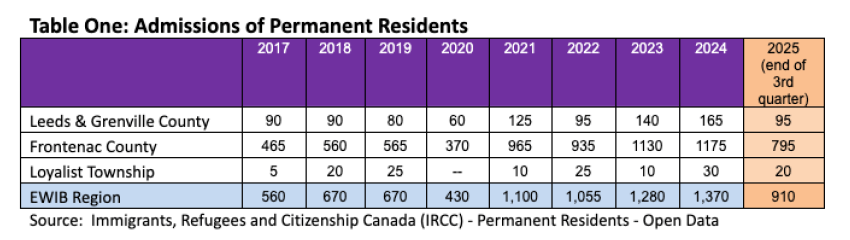
Table One shows the number of permanent residents that were admitted to the selected geographical areas. Over the last 3 years 2021-2024, the number of permanent residents admitted to the EWIB region has increased significantly compared to previous years.
The province explains that after immigration declined in 2020 and 2021 due to the impacts of the COVID-19 pandemic, Ontario admitted a record-breaking number of immigrants. This was largely the result of the easing of pandemic border restrictions, efforts to lessen the administrative backlog and higher immigration targets introduced by the federal government. Table Two addresses the International Mobility Program and Temporary Foreign Worker Program.
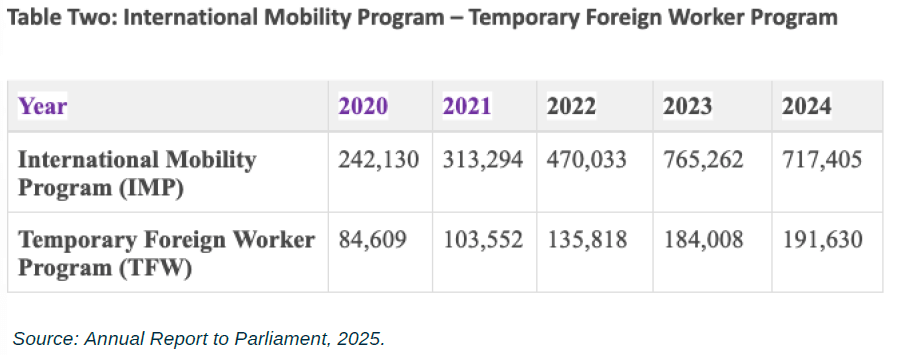
As the Region transitions into 2026 and beyond, its ability to respond to workforce needs will be impacted in part by how it responds to reductions in the numbers of immigrants, temporary foreign workers and international students. Cuts to the numbers of persons allowed to immigrate affect a broad set of sectors and employment classification roles.
1 CTV News, Immigration Targets 2026
2 Eastern Workforce Innovation Board, Local Planning Report 2024/25
3 Annual Report to Parliament on Immigration, 2025
4 Global News, Budget and Immigration Targets, Nov 2025
5 St. Lawrence Rideau Immigration Partnership, Immigrant Experiences, 2025
6 Immigration and Health Care, Statistics Canada
7 Government of Canada, Citizenship and Immigration
Local Job Postings
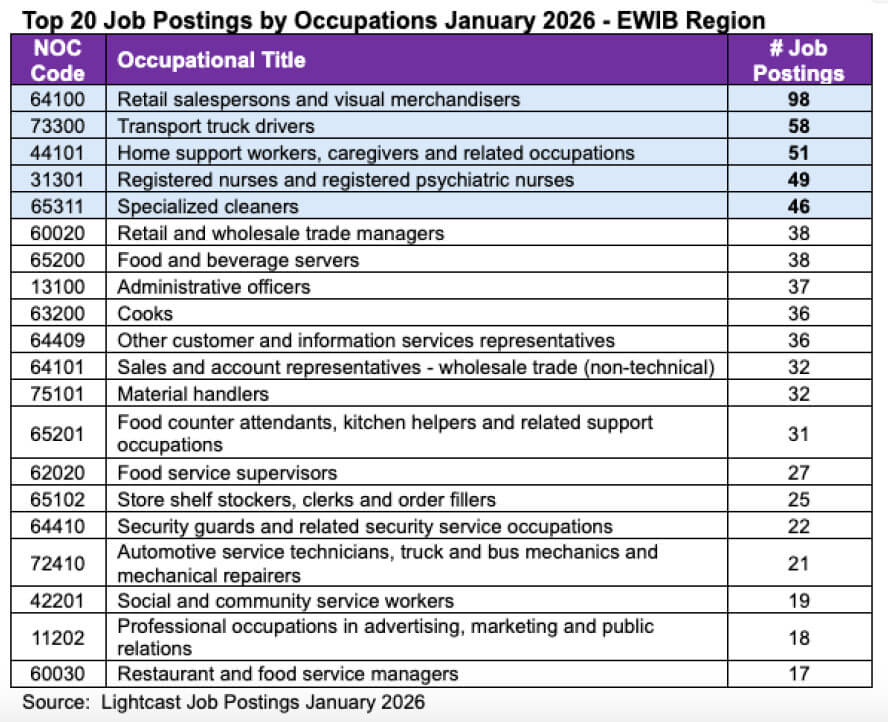
This section provides information on local jobs that are in demand by reviewing data of the job hubs on the EWIB web-site. Click here to visit the EWIB’s job board.
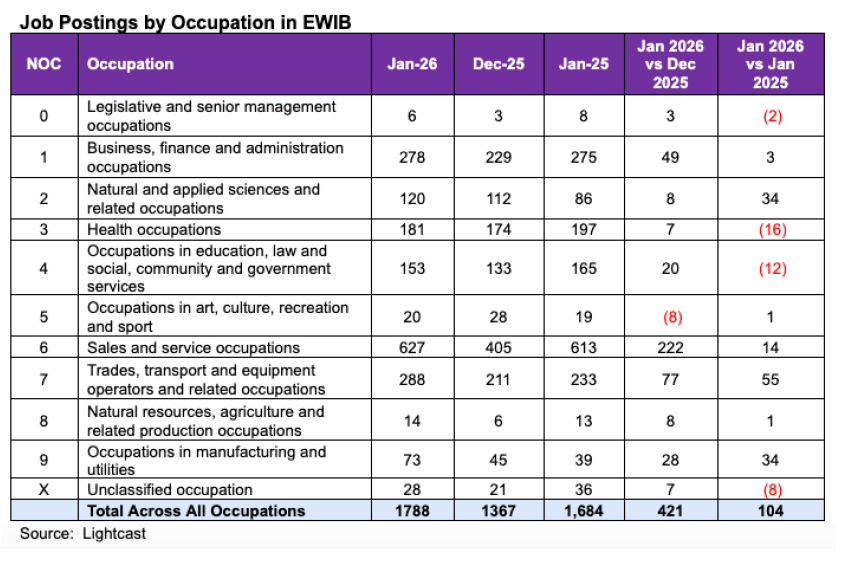
EEWIB Region includes the counties of Leeds & Grenville and Frontenac and the township of Loyalist.
In January 2026 there were 1,788 new job postings. This was an increase of 421 job postings from the previous month of December and an increase of 104 job postings from a year ago reported in January 2025. The most significant increase in job postings from last month was in sales and service occupations of 222 jobs. Compared to last year, the largest increase of job postings was in trades, transport and equipment operator occupations of 55 jobs.
LMI HELP DESK
EWIB provides a free Labour Market Information (LMI) Help Desk Service to the public. Questions can be submitted by completing an online form and a response will be sent to you within 5 business days. Click here to request local labour market information from our LMI Help Desk.
Text originally published at: Eastern Workforce Innovation Board (EWIB)